
TORONTO, ON – September 11 2026 – Revival Gold Inc. (TSX-V: RVG | OTCQX: RVLGF), a featured company in The Resource Vault, has completed the 2026 infill drilling program at its Mercur Gold Project in Utah.
The Company drilled approximately 10,000 metres across 100 reverse-circulation holes with one purpose: to upgrade Inferred Mineral Resources into the Measured and Indicated categories needed to support a Preliminary Feasibility Study, or PFS, planned for the end of Q1 2027.
The latest results support the grades and heap-leach characteristics used in the 2025 Mercur PEA. They also point to potential additional heap-leachable mineralization beyond the current PEA mine plan. This is not a resource update. It is the methodical technical work required to move Mercur from a preliminary economic study toward the next stage of development.
Recent Drill Highlights
| Hole | Area | From (m) | Width (m) | Gold Grade (g/t Au) | Cyanide-Soluble Gold Ratio |
| RM26-180 | Main Mercur | 65.5 | 29.0 | 1.82 | 83% |
| RM26-193 | Main Mercur | 16.8 | 45.7 | 1.32 | 94% |
| RM26-201 | Main Mercur | 68.6 | 54.9 | 0.90 | 91% |
| RM26-192 | South Mercur | 12.2 | 44.2 | 0.75 | 97% |
| RM26-207 | Main Mercur | 115.8 | 64.0 | 0.97 | 96% |
| RM26-191 | South Mercur | 85.3 | 45.7 | 0.68 | 92% |
| RM26-199 | Main Mercur | 44.2 | 9.1 | 3.15 | 59% |
| RM26-200 | South Mercur | 85.3 | 7.6 | 2.66 | 100% |
True widths are estimated at 60% to 95% of drilled widths. The cyanide-soluble gold to fire-assay ratio provides an early indication of the potential heap-leach recoverability of the sampled material. It is not a metallurgical recovery estimate.
The grade and width of the results are important. So are the cyanide-soluble ratios. The broader intervals at RM26-193, RM26-201, RM26-192, and RM26-207 all reported ratios above 90%, consistent with the low-cost crushed-ore heap-leach approach that underpins the Mercur development plan.
“Gold grades, cyanide soluble to fire assay ratios, and encountered geology continue to support Revival Gold’s expectations for the project coming out of last year’s PEA,” said Hugh Agro, President and CEO of Revival Gold.
The Main Mercur Results
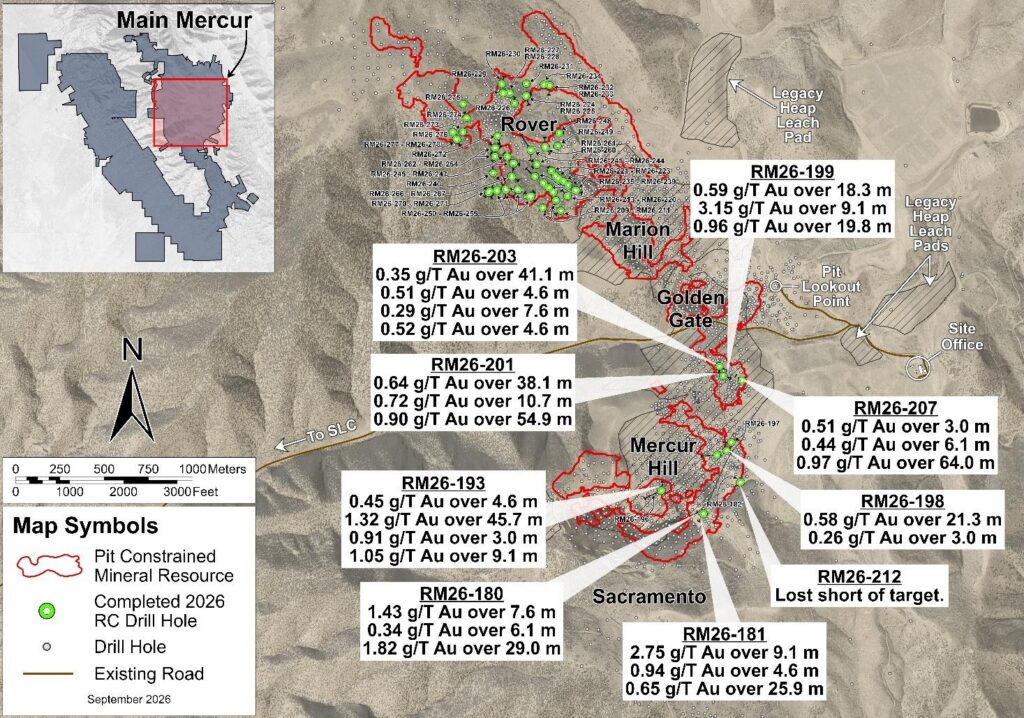
Figure 1. Main Mercur drill plan map. The 2026 infill program tested the resource footprint across Rover, Marion Hill, Golden Gate, Mercur Hill, and Sacramento. The map highlights broad intervals from RM26-180, RM26-193, RM26-201, and RM26-207. It also shows existing roads, legacy heap-leach pads, and the established site footprint at Mercur.
The Main Mercur results include 29.0 metres at 1.82 g/t gold in RM26-180, 45.7 metres at 1.32 g/t gold in RM26-193, 54.9 metres at 0.90 g/t gold in RM26-201, and 64.0 metres at 0.97 g/t gold in RM26-207. These are the types of intervals that support resource conversion, particularly when they show strong cyanide solubility.
South Mercur Continues to Add Context
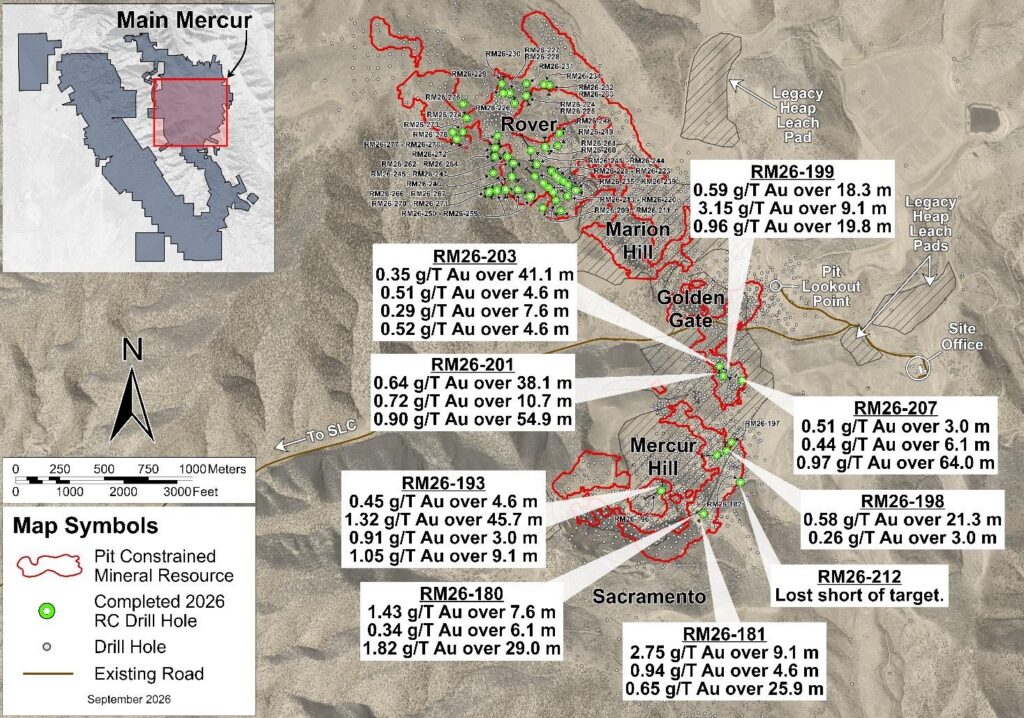
Figure 2. South Mercur drill plan map. Completed 2026 RC holes are located within and along the pit-constrained mineral-resource outlines. The highlighted results include RM26-192, which returned 44.2 metres at 0.75 g/t gold with a 97% cyanide-soluble gold ratio, and RM26-191, which returned 45.7 metres at 0.68 g/t gold with a 92% ratio.
Revival Gold has stated that its infill results to date support the grade and leachability assumptions used in the PEA while highlighting potential expansion opportunities outside the existing mine plan. The average infill hole depth was only about 100 metres, and the Company has identified open structures to the east, west, and at depth across the deposit.
Figure 2. South Mercur drill plan map. Completed 2026 RC holes are located within and along the pit-constrained mineral-resource outlines. The highlighted results include RM26-192, which returned 44.2 metres at 0.75 g/t gold with a 97% cyanide-soluble gold ratio, and RM26-191, which returned 45.7 metres at 0.68 g/t gold with a 92% ratio.
Revival Gold has stated that its infill results to date support the grade and leachability assumptions used in the PEA while highlighting potential expansion opportunities outside the existing mine plan. The average infill hole depth was only about 100 metres, and the Company has identified open structures to the east, west, and at depth across the deposit.
The Work Is Not Finished
The Company has released results from 30 of the 100 completed infill holes so far. Assays from the remaining approximately 70 infill holes are expected over the next couple of months as they become available.
Three rigs remain active at Mercur. The remaining 2026 program includes approximately 2,500 metres of RC drilling and 1,200 metres of auger drilling to test potential resource expansion opportunities, as well as roughly 4,100 metres of geotechnical, hydrological, metallurgical, RC, core, and auger drilling. In total, Revival Gold expects to complete about 18,000 metres at Mercur in 2026.
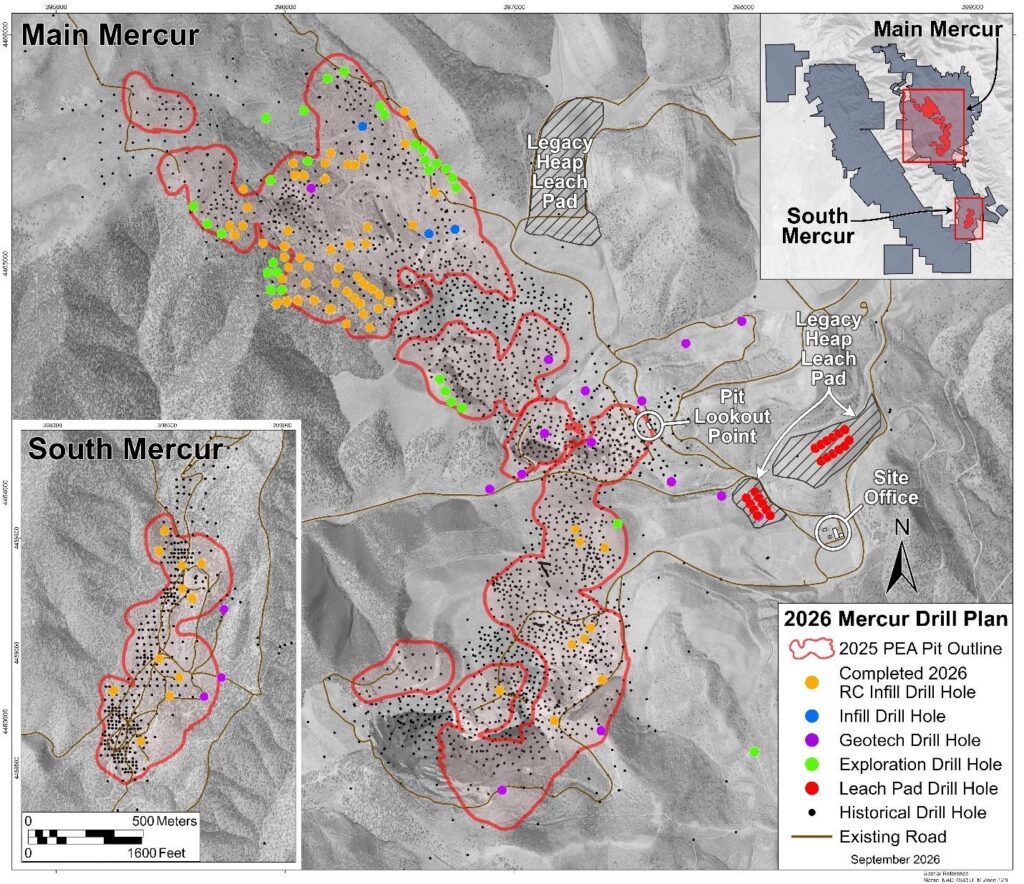
Figure 3. 2026 Mercur drilling-program overview. The completed infill program is one component of a broader 18,000-metre campaign. The plan also includes exploration drilling, engineering work, and leach-pad drilling across Main Mercur and South Mercur, all positioned relative to the 2025 PEA pit outlines.
The Resource Vault Perspective
The market often wants new ounces from every drill release. This update is about something different and just as important: reducing uncertainty ahead of the PFS.
Mercur’s 2025 PEA outlined an after-tax NPV of $752 million at a gold price of US$3,000 per ounce. The task now is to demonstrate that the resource grade, oxide character, and heap-leach assumptions stand up under closer-spaced drilling and engineering work. The first 10,000 metres of infill drilling are doing that.
The strongest part of this update is the combination of broad mineralized intervals and consistently high cyanide-soluble gold ratios. The results do not yet prove an expanded resource or improve the PEA economics. They do, however, support the technical assumptions that need to hold as the Company works toward a PFS at the end of Q1 2027.
With results from approximately 70 infill holes still pending and drilling continuing across exploration and engineering targets, Mercur should provide steady news flow through the balance of 2026.
For our full initiation report on Revival Gold and to track future developments, visit the Revival Gold Company Page on The Resource Vault.
→ Read Our Initiation Report: “The $2 Billion Gold Company You Can Buy for $200 Million”
About Revival Gold Inc. Revival Gold is one of the largest pure-play gold mine developers in the United States. The Company is advancing the Mercur Gold Project in Utah and conducting exploration at the Beartrack-Arnett Gold Project in Idaho. Revival Gold is listed on the TSX Venture Exchange under the symbol “RVG” and trades on the OTCQX Market under the symbol “RVLGF.”
Cautionary Statement This release contains forward-looking statements, including statements regarding potential resource conversion, potential expansion opportunities, the timing of assay results, the scope of the remaining 2026 drilling program, and the timing of a PFS targeted for the end of Q1 2027. Forward-looking statements are based on current expectations and involve risks and uncertainties. Actual results may differ materially from those anticipated. The PEA is preliminary in nature and does not constitute a feasibility study. There is no certainty that the PEA results will be realized.
Disclosure: The companies promoted on The Resource Vault have been disseminated on behalf of Equity Catalyst Partners, LLC. Equity Catalyst Partners, LLC has been engaged by these companies to provide marketing and investor relations services and is compensated by each company. This is not financial advice.