
The NE Tyro Zone Keeps Getting Bigger and Wider at Depth
VANCOUVER, BC – July 9, 2026 – As a featured company in The Resource Vault, West Point Gold Corp. (TSX-V: WPG | OTCQX: WPGCF) has released another set of significant drill results from the NE Tyro Zone at its flagship Gold Chain Project in Arizona — and the picture emerging from the drills is becoming increasingly compelling.
Two new holes — GC26-168 and GC26-161 — have extended the high-grade zone further down-dip, confirming that the NE Tyro system is widening at depth, not narrowing. With 19 holes and approximately 5,920 metres of assays still pending, and a Maiden Resource Estimate (MRE) due later in 2026, the best chapters of this story are still being written.
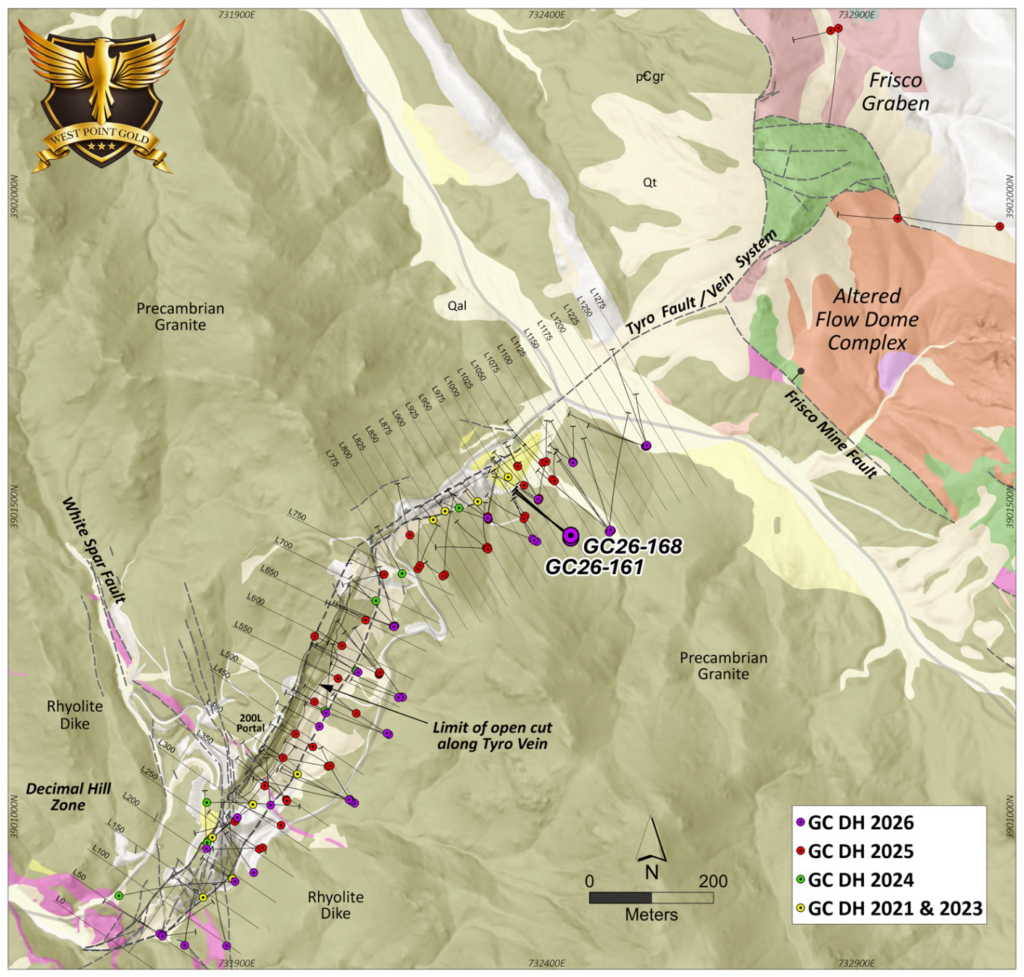
Figure 1. Plan view of the Main Tyro vein showing geology and drilling conducted in 2021, 2023, 2024, 2025, and 2026. The new holes GC26-161 and GC26-168 are positioned within the NE Tyro corridor, continuing to trace the system along a broader mineralized trend.
Drill Highlights
| Hole | Type | From (m) | To (m) | Downhole Width (m) | Est. True Width | Grade (g/t Au) |
| GC26-168 | RC | 242.3 | 298.7 | 56.4 m | ~28 m | 4.24 |
| Including | 269.8 | 298.7 | 28.9 m | ~14 m | 7.77 | |
| GC26-161 | Core | 210.5 | 278.7 | 68.2 m | ~40 m | 2.20 |
| Including | 244.5 | 278.7 | 34.3 m | ~17 m | 3.57 |
True widths are estimated at 50–60% of downhole widths.
Both holes were drilled approximately 250 metres below surface, targeting the down-dip extension of the NE Tyro zone between the previously reported high-grade intercept in GC26-148 (66.2m at 6.57 g/t Au) and GC26-157 (31m at 3.4 g/t Au). The zone remains open at depth and in all directions.
“With these results and GC26-148, the apparent widening, along with the textures observed, suggests multiple gold mineralizing events with deposition over a greater vertical range than you would typically see in low sulphidation epithermal systems. These results further support the zone remaining open to depth,” said Derek Macpherson, President & CEO.
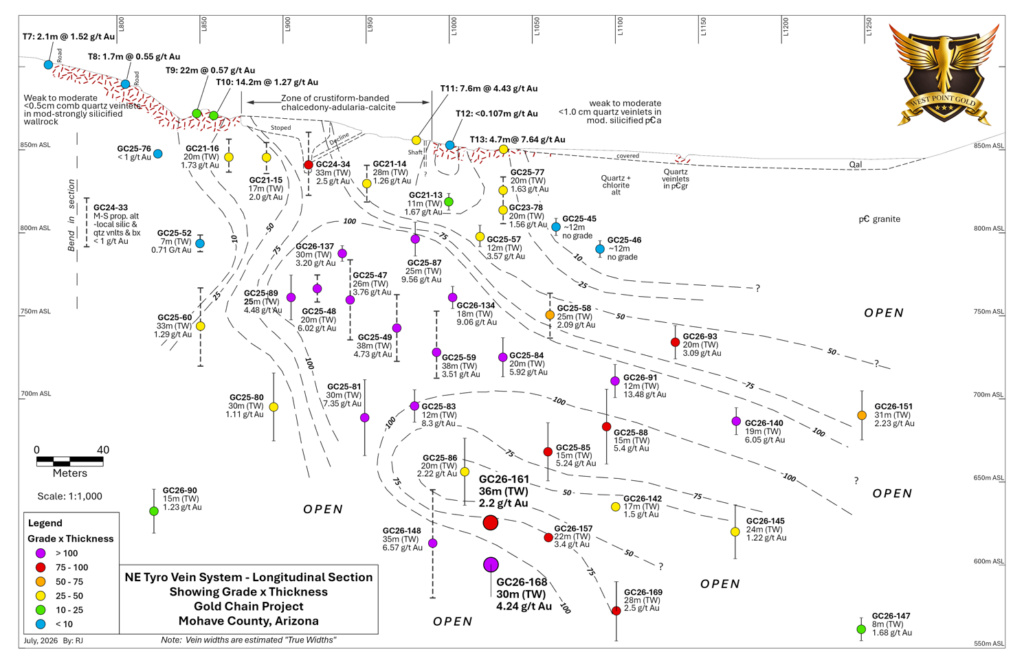
Figure 2. Longitudinal section showing grade x thickness across the NE Tyro vein system. Both GC26-161 and GC26-168 sit inside the GT >100 contour, reinforcing that the new holes are not isolated hits but part of a coherent high-grade shoot that remains open below the current drilling envelope.
Why the Widening Matters
The detail that stands out most in this release is not any single grade or width; it is the consistent pattern of widening at depth now confirmed across multiple holes. GC26-148 first signalled this trend; GC26-161 and GC26-168 now corroborate it from a different angle and at a comparable depth.
The geological explanation is significant. The vein system appears to steepen toward near-vertical at approximately 200 metres below surface, which is expanding the “damage zone”: the broad envelope of fractured, altered, and mineralized rock surrounding the principal vein. The presence of multi-stage quartz-chalcedony-calcite-adularia breccias, bladed calcite textures, and fine-grained intrusive phases acting as preferential fluid pathways all point to a system that was repeatedly recharged with gold-bearing fluids over time. This is the geological architecture of a large, enduring hydrothermal system: the kind that produces world-class deposits.
The use of both core (GC26-161) and reverse circulation (GC26-168) drilling in adjacent holes at the same depth is also notable. The close agreement between the two methods validates the grade and width estimates and strengthens confidence in the upcoming resource model.
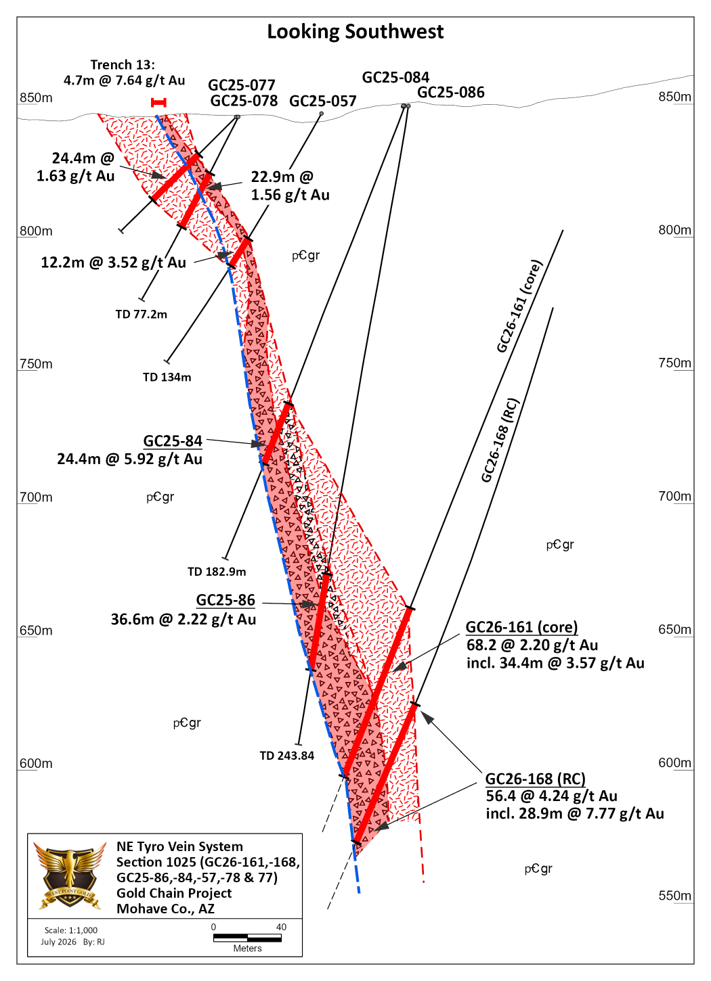
Figure 3. Geologic section through NE Tyro. The image shows the two new holes cutting a broad mineralized breccia zone at depth, visually reinforcing the company’s interpretation that the vein system steepens and broadens downward.
Visual Proof Inside the Core
The strongest drill releases are not just supported by assays — they are supported by rocks that look the part. In GC26-161, the core photo shows a broad interval of multi-stage vein breccia with strong quartz-chalcedony-calcite flooding and visible textural complexity. Labeled intervals grading 8.54 g/t Au and 9.21 g/t Au help illustrate why management continues to emphasize repeated gold-bearing fluid events over a broad vertical range.
For Resource Vault readers, this matters because core texture is often where the geological thesis becomes tangible. These are not narrow, one-off stringers. They are wide, brecciated, mineralized intervals consistent with a growing, high-energy epithermal system.
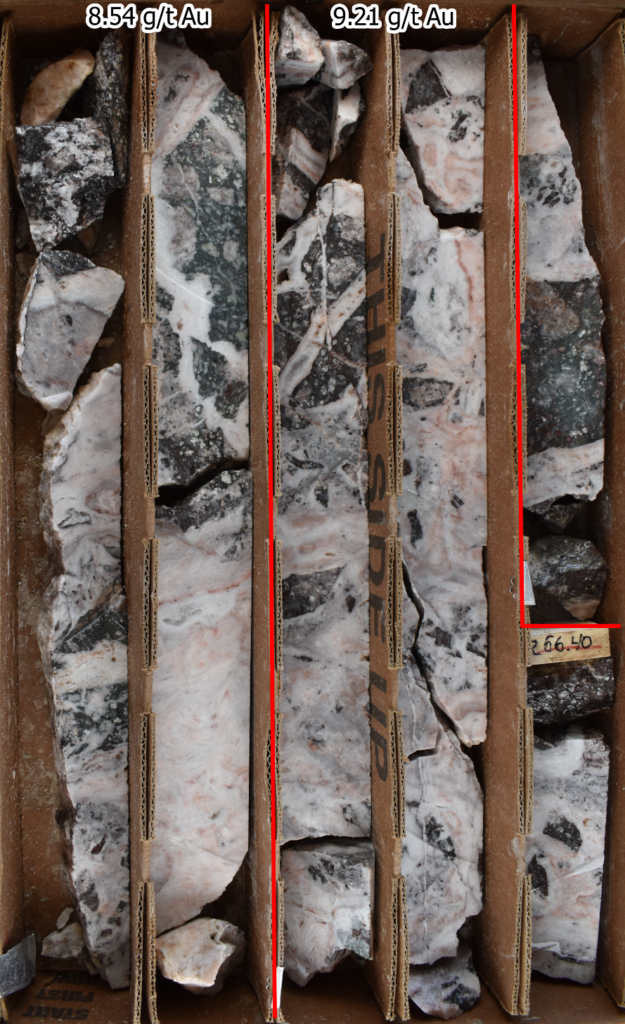
Figure 4. Core photo from GC26-161. The broad vein breccia textures and labeled high-grade intervals visually support the interpretation of a robust, multi-stage mineralizing system.
The Resource Vault Perspective: A Pattern, Not a Single Hole
When we initiated coverage of West Point Gold, we highlighted three non-negotiable criteria for inclusion in the Vault: exceptional assets, proven management, and a clear path to value creation. The NE Tyro Zone is delivering on all three with each successive drill result.
What is emerging at Gold Chain is a repeating pattern of high-grade, wide, and deepening mineralization across a 1.2-kilometre strike length that the drills have not yet closed off. The MRE due later this year will be the first formal attempt to quantify what that means in ounces. Based on the intercepts to date, including 19 holes with assays still pending,that number has the potential to be a genuine market re-rating event.
At approximately $120 million USD in market capitalization, West Point Gold is being valued as an early-stage explorer. The drill results suggest it may be something considerably more significant.
For our full initiation report on West Point Gold and to track all future news releases, visit the
West Point Gold Company Page on The Resource Vault.
→ Read Our Initiation Report: “This Might Be the Greatest Comeback Story in Gold Exploration History”
Image Notes and Source
| Figure | Description | Source |
| Figure 1 | Plan view map showing the Tyro vein system and the locations of GC26-161 and GC26-168 | West Point Gold Corp. press release PDF: WPGPR#26-18-DrillResults-TyroNEGC26-161and-168-FINAL.pdf |
| Figure 2 | Longitudinal grade-thickness section highlighting both holes within the GT >100 zone | West Point Gold Corp. press release PDF: WPGPR#26-18-DrillResults-TyroNEGC26-161and-168-FINAL.pdf |
| Figure 3 | Geologic section showing the widening breccia zone and geometry of the new holes | West Point Gold Corp. press release PDF: WPGPR#26-18-DrillResults-TyroNEGC26-161and-168-FINAL.pdf |
| Figure 4 | Core photo from GC26-161 showing vein breccia textures and high-grade labeled intervals | West Point Gold Corp. press release PDF: WPGPR#26-18-DrillResults-TyroNEGC26-161and-168-FINAL.pdf |
Qualified Person Robert Johansing, M.Sc. Econ. Geol., P. Geo., Vice President, Exploration for West Point Gold, is a Qualified Person as defined by NI 43-101 and has reviewed and approved the technical content of this release. Samples were submitted to American Assay Laboratories (AAL) of Sparks, Nevada. Gold was determined by fire assay with an ICP finish; over-limit samples were determined by fire assay and gravimetric finish. Certified standards, blanks, and duplicates were inserted on-site and by AAL.
About West Point Gold Corp. West Point Gold is an exploration and development company focused on unlocking value across four strategically located projects along the prolific Walker Lane Trend in Nevada and Arizona, USA, providing shareholders with exposure to multiple discovery opportunities across one of North America’s most productive gold regions. The Company’s near-term priority is advancing its flagship Gold Chain Project in Arizona. West Point Gold is listed on the TSX Venture Exchange under the ticker symbol “WPG” and trades on the OTCQX Market under the ticker symbol “WPGCF”.
Cautionary Statement Neither the TSX Venture Exchange nor its Regulation Services Provider accepts responsibility for the adequacy or accuracy of this release.
This release contains “forward-looking information” and “forward-looking statements” within the meaning of applicable securities legislation. Forward-looking statements include estimates and statements that describe the Company’s future plans, objectives or goals. Forward-looking statements in this release include, but are not limited to: the timing of the Company’s Maiden Resource Estimate; the belief that the NE Tyro Zone will remain open to depth following that estimate; and the expectation that pending assay results will contribute to the upcoming resource estimate. Forward-looking statements involve significant known and unknown risks and uncertainties, should not be read as guarantees of future performance or results and will not necessarily be accurate indicators of whether or not such results will be achieved. For a more detailed discussion of such risks, refer to the Company’s public filings available on SEDAR.
Disclosure: The companies promoted on The Resource Vault have been disseminated on behalf of Equity Catalyst Partners, LLC. Equity Catalyst Partners, LLC has been engaged by these companies to provide marketing and investor relations services and is compensated by each company. This is not financial advice.